.png)
 10 hours ago
1
10 hours ago
1
As the US’s network for monitoring air pollution deteriorates, a Floodlight investigation has found that the chemical industry is going state-to-state to restrict one of the few options citizens have left for holding polluters accountable: low-cost air sensors.
Over the past two years, the non-profit investigative newsroom determined, lawmakers in Louisiana, Kentucky and Ohio have passed strikingly similar laws barring regulators from acting on air-quality data that communities collect themselves – unless it comes from Environmental Protection Agency (EPA)-approved equipment that typically costs tens of thousands of dollars. Similar legislation has repeatedly been introduced in West Virginia.
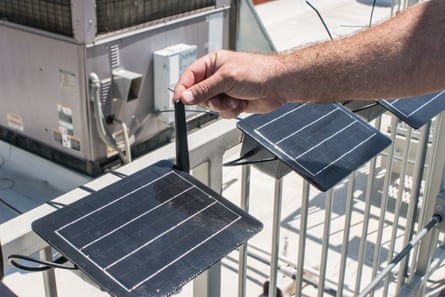
In case after case, industry has made the same argument: community monitoring is not reliable enough for regulatory enforcement.
Yet when lawmakers in West Virginia offered a version of a bill that would have let regulators consider community data if it met manufacturer requirements, industry refused to back it.
The bill “essentially codifies what we are trying to prevent”, wrote Jeff Fritz, an official with the chemical giant Chemours, in an internal email. Bill Bissett of the West Virginia Manufacturers Association wrote that the compromise “neuters” the measure and left it “toothless”. That bill died, along with versions in 2025 and 2026.
Ohio slipped its monitor restriction into a budget bill last year, prompting a lawsuit from a group of plaintiffs including Donna Ballinger.
Ballinger has a low-cost monitor in her front yard in Middletown, Ohio, a few hundred feet from a steel plant that she says frequently sends black, white and gray particles on to her property. Fumes sometimes burn her eyes and throat, she said, and she often holds her nose when walking between her house and car.
“My fear is cancer,” she said.
The lawsuit she helped file alleges that the new rules make her monitor’s readings useless as evidence.
An early-warning system in decline
People have turned to low-cost sensors at a time when the public network they used to rely on is thinning out. Federal grants supporting that network have fallen more than 35% over the past two decades, adjusted for inflation, and the number of government air monitors nationwide has fallen by nearly half over the same period, according to EPA data.
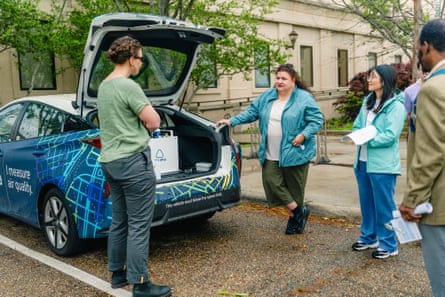
Today, nearly six in 10 US counties have no public air monitor at all, according to a 2025 study.
And what remains is showing its age. Leaks, termites and ants plague monitoring stations in one state while officials in another have resorted to shopping on eBay for discontinued parts, according to a 2020 congressional watchdog report. The report doesn’t specify to which states it is referring.
Floodlight examined the largest industrial sources of air pollution in Kentucky, Louisiana, Ohio and West Virginia – and compared the chemicals they reported releasing with what government monitors in those states can detect. At 71 of the 100 facilities examined, the chemical released in the greatest quantity is not measured by any government monitor in the state.
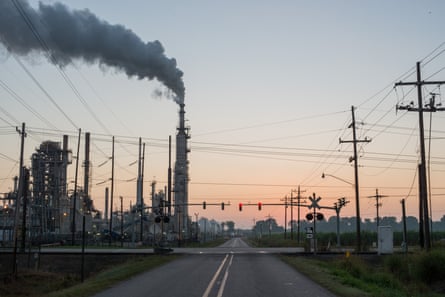
In Louisiana, a national center of oil, gas and petrochemical production, public monitors are often miles from major industrial polluters and fail to test for some of the most dangerous chemicals.
Community groups tried to close that gap. A $500,000 federal grant would have let the Louisiana Environmental Action Network (LEAN) monitor 27 communities it identified as pollution hotspots. But the group installed monitors in only four communities before the Trump administration canceled the grant last year.
“It’s like having your legs knocked out from under you,” LEAN executive director Marylee Orr said.
A multi-state push
Meanwhile, Louisiana lawmakers in 2024 passed the Community Air Monitoring Reliability Act, a law drafted with help from the state’s Chemistry Association that says data used in enforcement must meet EPA-approved standards.
Kentucky followed in 2025, passing a similar measure which requires “scientifically defensible” methods. That phrase had appeared in an American Chemistry Council (ACC) blog post two years earlier. The ACC then lobbied for the Kentucky bill alongside the American Petroleum Institute as well as Chemours and fellow industry powerhouse Dow Chemical.
Kentucky already had proof that monitoring works. Regulators there documented toxic air around Louisville’s industrial Rubbertown, then enacted a plan and revised regulations. As a result, toxic air contaminants across the metro area fell by almost 80%, while the most dangerous chemicals fell by 96%.
The ACC did not answer questions about its lobbying or its role in promoting the state legislation, though it said in a statement that it has invested in community air-monitoring projects and advocated for “expanded access to credible air quality information”.
Chemours spokesperson Jess Loizeaux said the company objects to community-monitoring results being used for enforcement without first verifying their validity and accuracy through official tests by trained regulators.
Ohio’s chemical trade group did not respond to interview requests. But the Ohio Chamber of Commerce’s general counsel, Tony Long, said businesses worry that uncalibrated monitors will spread misinformation. “You don’t want to be stopped for speeding on an uncalibrated speed gun,” he told Floodlight.
In Louisiana, meanwhile, resident Reonda Victor lives in the heavily industrialized corridor between Baton Rouge – the state’s capital – and New Orleans, its most famous city, where air pollution poses one of the highest cancer risks in the US. The closest public monitoring station to her home tests only for lead.
She can’t say whether industrial pollution caused her mother, grandmother and sister to all have breast cancer. But what she knows is she underwent genetic testing, and she showed no predisposition to breast cancer, she said.
And she said she wondered if proper air monitoring could help answer whether industrial pollution factored into her family members’ illness
As she put it: “Without information, we don’t know.”
Read the full investigation at Floodlight





 English (US) ·